What is up everyone! I am here with my final project for the Programming and Robotics class. There will be all sorts of things from codes you can tinker with to articles on the most recent tech news to a group website on how to do well in Geoguessr.
Python Projects
These were my Twin Python Projects, where we had to do a number project and a word project. One of them is a story where you have multiple options to progress the story from. The other one is a highlow game where you keep guessing until you get it right, Try them both out!
A fun game 2 player game called buckshot roulette, similar to the infamous game Russian Roulette, with a similar concept, but also with the addition of items. Try to play it!
News Articles
First article

As our society progresses, we can see a lot of progress in the AI sector as well, and this is especially true for the relatively new o3-mini. The difference between o3-mini and its more famous counterpart 4o is that o3-mini prioritizes a correct answer and uses much more reasoning compared to 4o. 4o prioritizes a quick answer given to you almost immedietly, and has a better overall user experience.
Personally, I am still going to be using 4o, as usually when I use AI, I want a quick answer even though it might not be as comprehensive as o3-mini. It takes a while for it to think of an answer, and there is limited use of it as well. However, OpenAI did mention releasing a full version o3, but for now that isnt the case. However, if there is a big project coming up and I need the best answers rather than the fast one, then o3 would be my choice. Because of its more logical thinking and higher reasoning ability, o3-mini can get better results overall, and I need that for big projects rather than needing speed. To summarize, use 4o for daily tasks and quick answers, and use o3-mini for big projects and comprehensive answers.
Second Article
Scientists were able to solidify light(somehow) into a supersolid, which has 2 contradictory properties, similar to light. It has a rigid structure(like a solid) which gives it that shape on the right, but also can flow around each other(like a liquid). Light also has contraditory properties, being both a particle and a wave, which shouldn’t be possible. They made it by trapping light using lasers to create a structure and cooling it down a lot in order to solidify it.
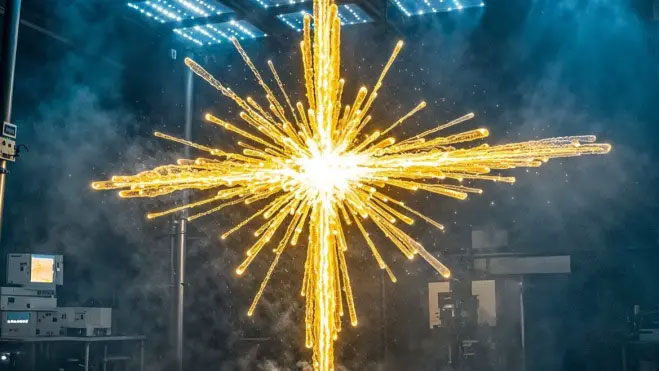
To me, this is suprising that we were even able to solidify light at all. I always thought of it as the fastest thing in the universe, and being able to see it still is still wild to me. There are multiple applications for this, including sensors for things like gravitational waves or magnetic forces. However, it can also be used for computing as well. Because of the way the supersolid works, it can act as an ultrafast proccessor while using little to no energy(not including the energy to cool down). However, because it needs to be cooled, I don’t think it would be in our computers any time soon.
Poppy
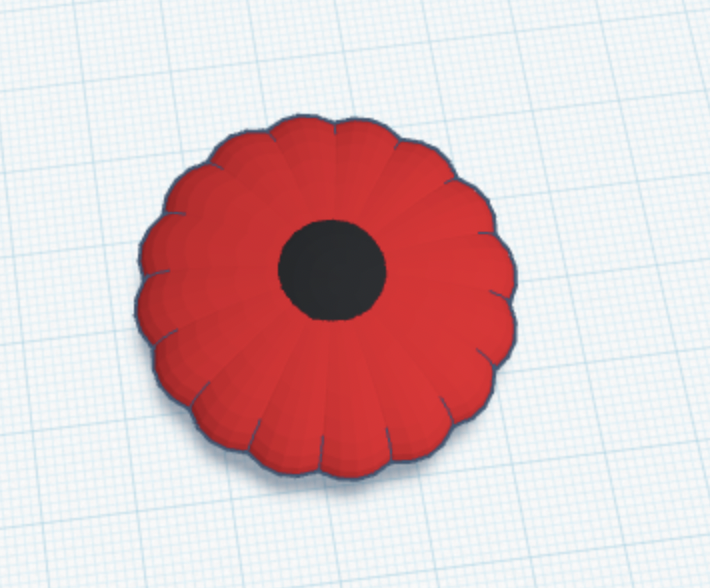
For this we had to create a poppy using vector art. However, there was some issues with using adobe illustrator, so instead, I made one in tinkercad that can be 3d printed immedietly if need be.
NHL Predictions

For our NHL unit, we had to make predictions on 25 players we chose and see how far off we were from the points after the official points came out. I chose the entire Canucks roster and compared my predicted points to their actual points. We did this by looking at their PPG(points per game) over 2 seasons and then multiplied it by the number of games they played in order to see how many additional points they would get. Finally, we added it to their current points to get our future points. As you can see from the graph, I did pretty well on my predictions except for April 4th, where we had to account for 9 games into the future. This means that worse performance or better performance would be amplified by 9 games instead of 4. This also led to room for injury, which did happen, leading to more inconsistancies.